I’ll confess to not having yet seen Trainwreck: Woodstock ’99, the Netflix documentary series that has inspired this article, but I’m familiar with the festival’s uncomfortable place in music history.
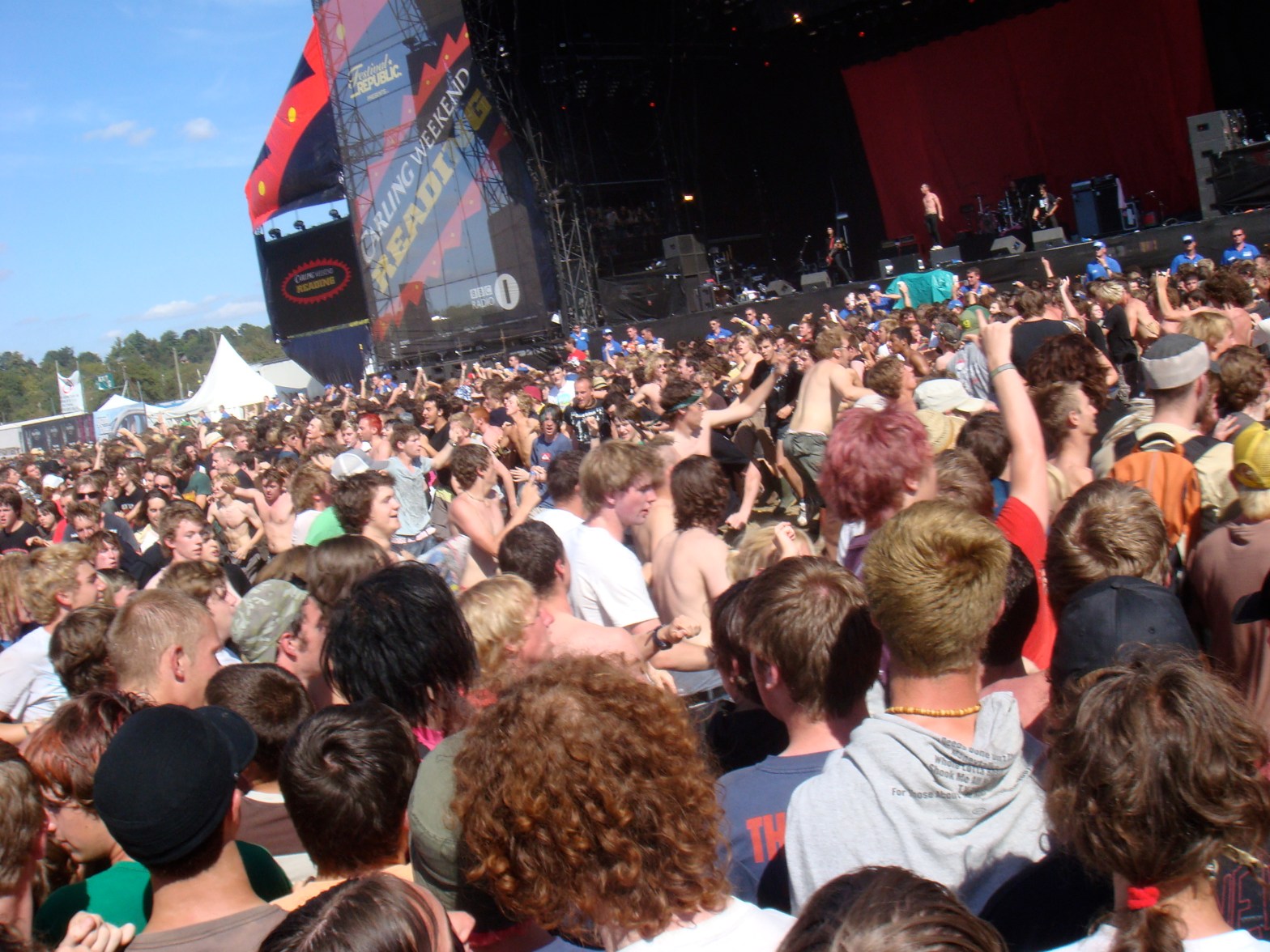
I’ve also never been to a Woodstock event, the furthest from home I’ve travelled for a music festival was Groezrock in Belgium. I did however clock up five straight years (plus a few extra days either side) at one of the biggest on home turf, Reading.

It never reached the apocalyptic level of all-out carnage seen at Woodstock in 1999, though there were a few moments throughout the years that probably had the organisers concerned things might tip over the brink. I slept peacefully through the mayhem in 2006 that led to major security changes at the event.
My first hand experience came in the form of me leading a conga line through the all day & night breakfast tent in the early hours of the morning. I woke up the next day to find they’d put reinforced fencing around the multiple entrances to avoid such an event taking place again. If anything I think I helped highlight a security risk.
I Preempted A Riot

When I first attended Reading Festival with a Friday day ticket in 2003, we were less than five years out from what had taken place in the US at Woodstock. Culture doesn’t shift that quickly and despite the zeitgeist altering world events that took place between 1999 and 2003, I think much of the underlying mentality that existed as tensions began to boil at Woodstock was still present as we moved into the 21st century.
It’s actually shocking to me now to think that organisers would book acts for Reading that they must have known would garner a negative response on the basis that they didn’t fit the surprisingly tight criteria of what was an acceptable billing. Throw them to the angry mob and see what happens.
Pop stars Daphne and Celeste were met with a wall of plastic bottles and, oddly, the letters S, K, C, O, L, L, O and B on individual pieces of paper, when they walked out on the Main Stage in August 2000. They both took the reception incredibly well and watching the performance back they look far more punk than anything I saw on ‘The Lock Up’ punk rock stage in subsequent years (including the nude frontman with a video camera taped to his head). The crowd by contrast look like absolute morons.
I wasn’t present for rapper 50 Cent’s similar experience in 2004, I did however go to express my feelings at Fightstar’s appearance in 2005. Fronted by former Busted member Charlie Simpson, Fightstar had a much heavier sound that really wasn’t at all out of place at Reading Festival. The issue some of us took (a whole tent full to be clear) was that a ‘pop star’ dared to reinvent themselves and come to our festival, on a slot that other bands would have had to work hard to earn.
How lame that I, and thousands of others, could’ve been at any of the other stages watching the bands who HAD done exactly what I expected them to do. In my defence I was an insecure 17 year old at the time, plenty of others there were older and probably should’ve known better. Including the organisers who felt it right to stir things up by playing that particular Kaiser Chief’s song before Fightstar took the stage.
I certainly didn’t throw anything, other than perhaps a middle finger in the air. We mostly booed for a bit and then went to the Ben and Jerry’s ice cream stand.
Charlie had the last laugh. Fightstar overcame the initial adversity and proved themselves as a credible act. He followed this with successful solo records before a return to Busted who were one of the biggest draws of the day at Slam Dunk Festival, a predominately punk event in 2019. I didn’t see them on that day, I’d long learnt my lesson of focusing on what I liked and skcollob to the rest.
Are The Times a-Changing?

I wonder if some of these particular toxic masculine traits are specific to the generation that gave us Woodstock ’99. I was reminded of this petty macho attitude when it was announced that 90’s legends Rage Against The Machine had pulled out of their headline slots at this weekend’s events at Reading and Leeds, to be replaced with The 1975.
The comments online were as you’d expect them to be, and musically I can understand that someone set in their ways may view the difference between RATM and The 1975 as a massive gulf. I see The 1975 as being socially aware in a way that actually reminds me of RATM’s conviction. They invited Greta Thunberg to open their 2020 album Notes on a Conditional Form with a blunt warning about climate change, for example.
Ironically, the spoken word track leads into People, The 1975’s heaviest and most politically charged material to date. Watch this video from when they opened with it for their headline set at Reading in 2019. They released the song the day before this show and the response to a track less than 48 hours old in the public conscience is insane. Factor in the stage production (lighting and visualisations) and this is one of the best Reading performances I’ve seen in 20 years of following the festival.
There’s a confidence that links right back to Daphne and Celeste performing Ooh Stick You! against all odds in that very same spot almost two decades earlier.
A lot DID change in the years I went to Reading Festival. Think ‘Fake News’ was born out of the Trumpian era? Nope. Go to any festival pre 2010 and you’ll come away loaded up on a version of reality entirely different to the bank holiday travellers using Reading’s transport hub a couple of miles down the road.
I’m not talking about partaking in any illegal substances, this is about a time before something more truly addictive. The smartphone.
When you went to a festival you were shutting yourself off from the outside world for a few days. I think that was part of the charm. If some prankster wanted to start a rumour that a game show host or Coronation Street star had died, it wouldn’t take a lot for it to spread like wildfire across the camp site with no real way of verifying whether it was true or not.
Along with technology, music and how we consume it was quietly changing in the background. Having a near infinite amount of music accessible to you and on a device that fit in your pocket had a major influence on how people collected around music. Specialist genres were bolstered by acts not needing to fight for radio time or magazine space. The barriers to entering a scene (cost, knowledge, effort) were broken down.

The result was confidence in the industry to launch more festivals that catered to a particular music fan. Slam Dunk is a great example of this, it started as a punk club night in Leeds and has evolved over the past fifteen years into a multi stage festival across two sites in the North and South of England, hosting over 50,000 attendees each year.
At the same time this genre has almost disappeared entirely from the Reading and Leeds festival line up, with the exception of a few notable names. Unless I’m much mistaken 2022 is the first year R&L haven’t run a dedicated punk rock stage since the late 1990’s. Overall the line up has diversified, incorporating more genres, but without the depth of selection within each of those.
Having not been for over ten years now I can’t comment on how that’s changed the general attitude of those in attendance, although I get the sense people are going more with a thirst for the festival experience and less to police which acts should or should not be playing.
So, while I continue to work on my own expose, tell-all documentary, here’s a teaser trailer with my original filmed footage from Reading ’09.
 Liam Toms